
Minletpan, A Signpost Toward the Future
By: Saw Htee Hser
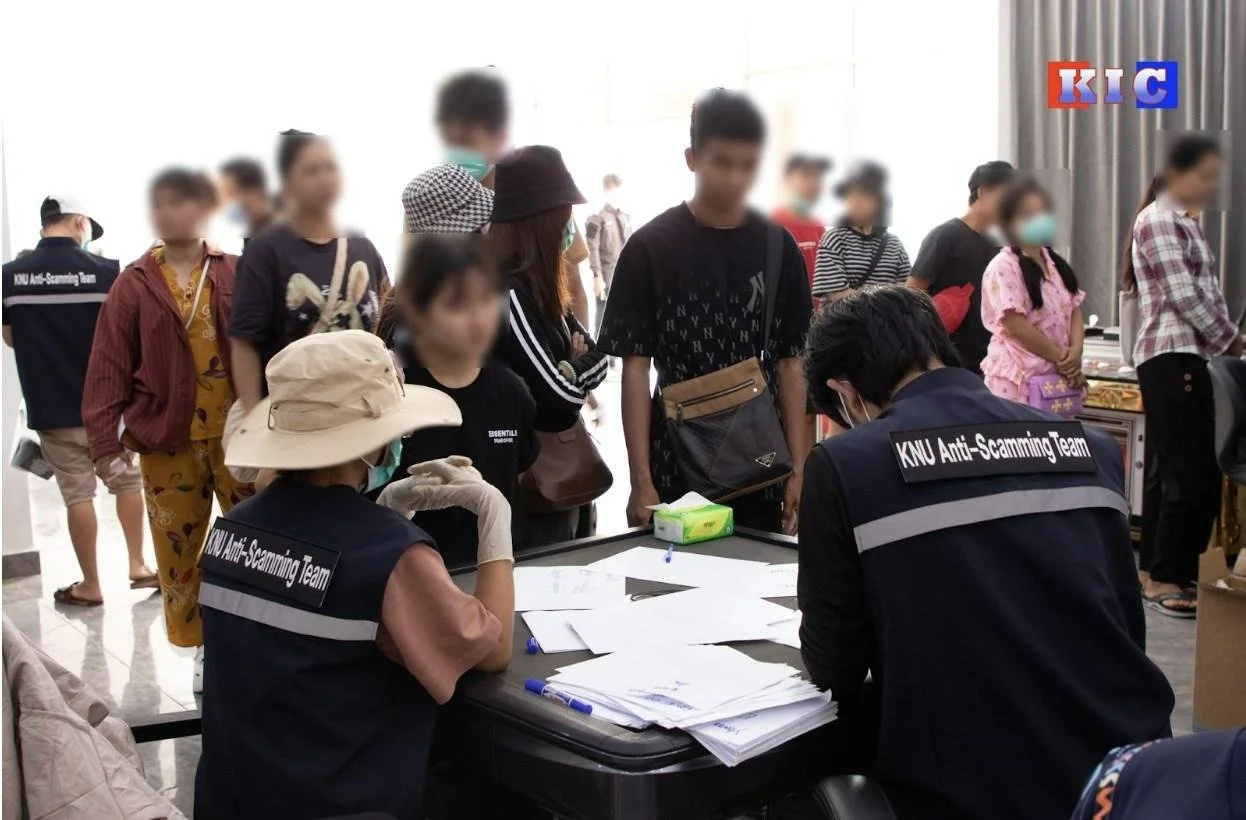
Photo caption: The Kawthoolei government (KNU) has set up a new police unit devoted to controlling the international scam centers along the Thai border. Currently deployed at the former DKBA scam center at Minletpan. (from Karen Information Center 11/27)
On November 21 the Karen army (KNLA/KNDO) took the unusual step of invading an enclave of an ethnic Karen armed splinter group allied with the Myanmar military junta, the DKBA. Minletpan, 15 km south of Myawaddy, hosted one of the international scam centers that have been the focus of Chinese and American law enforcement recently. The Karen National Union (KNU), the de facto government of Kawthoolei, thus found itself with custody of over 3,000 scam center workers and managers from 20 countries, as well as forensic evidence of the scam center's operations on thousands of electronic devices.
While this seizure may superficially resemble the recent closures of scam centers at KK Park and Shwe Kokko, it differs fundamentally in key respects. First, those closures were carried out by the same junta-aligned BGF militia that had overseen their operation for years, suggesting that the closures were mere publicity stunts to deflect pressure from the Chinese and American governments, which aim to protect their citizens from the scamming operations. The BGF provided safe passage for the Chinese criminal bosses to other enclaves where they can continue their operations, and even began construction of new scam bases at Maw Poe Kay and Thet K’Tay Sanpya. Secondly, buildings, cell phones, and computers that could have provided evidence have been destroyed by the BGF.
By contrast, the operation at Minletpan was by Kawthoolei authorities who have a direct interest in suppressing the crime hubs that funnel hundreds of millions of dollars annually to the Naypyitaw regime and its local proxies, whom the Karen army is fighting. The Kawthoolei National Police Force (KNPF) has set up a new Anti-Scamming Team, echoing America’s new Scam Center Strike Force, and it is now debriefing captured workers and cataloguing evidence in electronic devices and buildings.
Significantly, the KNPF has also contacted counterparts in Thailand and elsewhere to share evidence and request assistance in the criminal investigation. The KNU recognizes that prosecution of international organized crime exceeds its current law enforcement capacity, and wants help from Thailand, America, and China. With such collaboration, the Minletpan seizure and investigation could potentially be repeated up and down the border at the remaining scam centers, as well as other criminal sites like the DKBA methamphetamine factory near Kyaukhat in the same area.
That brings up the delicate problem that the KNU government is not recognized by those others outside of Myanmar, who consider it a "rebel group," and/or are unable to distinguish among the various military entities in the country. Thus, when the KNU requests help and collaboration, those external governments demure, fearing to get embroiled in Myanmar's civil war.
(For the uninitiated, Kawthoolei is the ethnic Karen nation, declared after the end of British colonial rule in 1949 and fighting a war for self-determination since that time. Geographically Kawthoolei encompases areas on Burmese-deliniated maps that correspond to Karen State, eastern Bago Division, northern Mon State, and most of Tanintharyi Division, including a long stretch of the Thai border.)
International police collaboration with the KNPF would imply external law enforcement taking sides against the unconstitutional Naypyitaw military regime. That partisanship is justified, even necessary, because it is the junta which has been fostering and benefiting from the scam centers. Law enforcement operations against the junta would be particularly problematic for China, which has backed it with military and surveillance hardware as well as economic pressure on opposition forces. China simultaneously deputizes the junta to protect its economic interests in Myanmar, while also goading it to shut down the scam centers that constitute one of the regime's revenue sources.
Foreign law enforcement engaging with the KNPF could arguably be a first step toward a broader collaboration with the KNU and other ethnic homeland governments for purposes such as border security, refugee repatriation, cross-border trade, transport, etc. As attractive as that would be to Kawthoolei, external governments have not yet reached a comfort level with such direct relations. They still prefer to interact with the Naypyitaw regime which is partly responsible for the crime hubs. Thailand has accepted Kawthoolei’s transfer of over 300 freed scam workers for repatriation to their countries in Africa and Asia, but otherwise the KNU is still waiting for international declarations of mobilization against the scam industry to materialize as action.
If international law enforcement fails to take advantage of this opportunity, the likely result is the indefinite continuation of the border crime hubs.
Sooner or later, other countries must recognize that the old unitary government in Naypyitaw is gone, replaced by a criminal cabal, and that the future must involve engagement with the ethnic nations that make up the new, looser Myanmar federal union. The law enforcement effort against the border scam centers shows that the time for that has already arrived.
Saw Htee Hser is the wartime moniker of an American humanitarian worker turned war reporter operating in Kawthoolei since 2019. He publishes the weekly progress report called Burma Coup Resistance Notes on Substack.